Year 2 Measurement Worksheets (Printable PDFs)
Printable Year 2 measurement worksheets from ZiloAcademy, covering comparing length, weight and capacity using informal units. Aligned with the Australian Curriculum (Version 9.0).
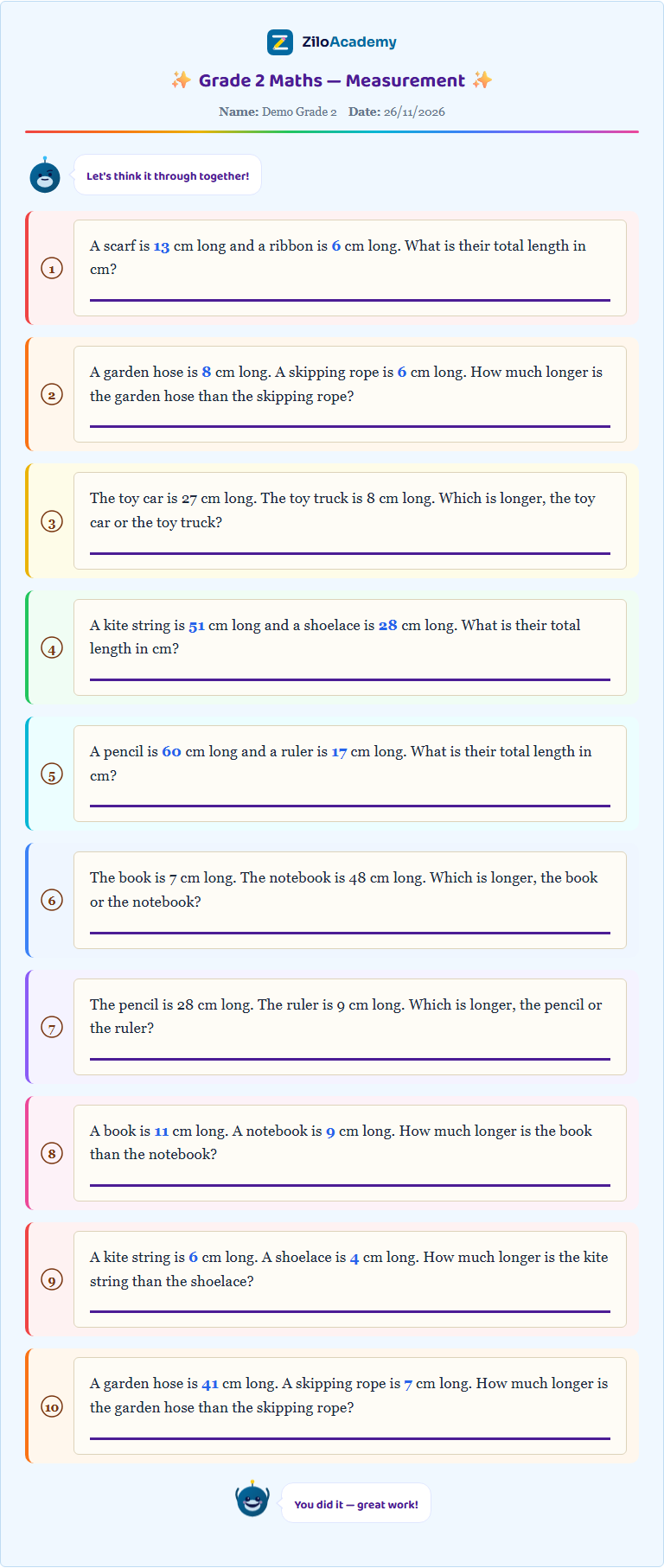
👆 This is what a real Year 2 Measurement Worksheets worksheet looks like
A real sample page — click the image to open the full worksheet and print it, with a fresh set of questions and an instant answer key.
👁️ View & Print This Worksheet →What Will Your Child Learn?
Year 2 measurement worksheets introduce comparing and ordering objects by length, weight and capacity, using informal units (hand-spans, blocks, cups) before formal units like centimetres and litres are introduced in later years. Worksheets include longer/shorter comparisons and reading simple scales.
Why Measurement Matters
Measuring with informal units first — rather than jumping straight to a ruler or scale — builds a genuine sense of what length, weight and capacity actually mean, because a child physically compares objects rather than just reading off a number. That intuitive sense is what later makes formal units (centimetres, grams, litres) feel like a sensible refinement rather than an arbitrary new system.
Measurement is also one of the clearest places where Maths connects visibly to everyday life — comparing who's taller, which bag is heavier, which cup holds more — and that visible relevance tends to make it one of the more naturally engaging topics at this age.
How to Print the Worksheets
- Select the worksheet you want and open its printable view.
- Press Ctrl+P (Windows) or Cmd+P (Mac), or use your browser's Print option.
- In the print preview, choose A4 paper size.
- Set the layout to Portrait (most worksheets) or Landscape if the sheet is wide.
- Check the print preview to make sure nothing is cut off — adjust "Scale" or "Fit to page" if it is.
- Turn on "Black and white" or "Grayscale" in printer settings to save colour ink.
- Click Print — or choose "Save as PDF" as the destination to keep a digital copy instead.
Works the same way whether you're printing from Chrome, Edge or Safari, on a desktop, laptop or tablet. Full details, including printing from a phone and fixing content that's cut off, are in our complete guide to printing worksheets at home.
Tips for Parents
- Compare everyday objects together by length, weight or capacity, and ask your child to predict before checking
- Use informal units around the house — how many hand-spans long is the table, how many cups fill a jug
- Introduce the idea that different informal units give different numbers for the same object — a useful early insight into why standard units matter
- Reading simple scales (even a kitchen scale) together is genuinely good, real-world practice
Frequently Asked Questions
📚 Helpful Guides for Parents
Get more out of every worksheet with practical tips from the Zilo Academy blog — study routines, NAPLAN advice and ways to support your child’s learning at home.