Year 3 Homophones Worksheets (Printable PDFs)
Printable Year 3 homophones worksheets from ZiloAcademy, covering words that sound the same but are spelled differently. Aligned with the Australian Curriculum (Version 9.0).
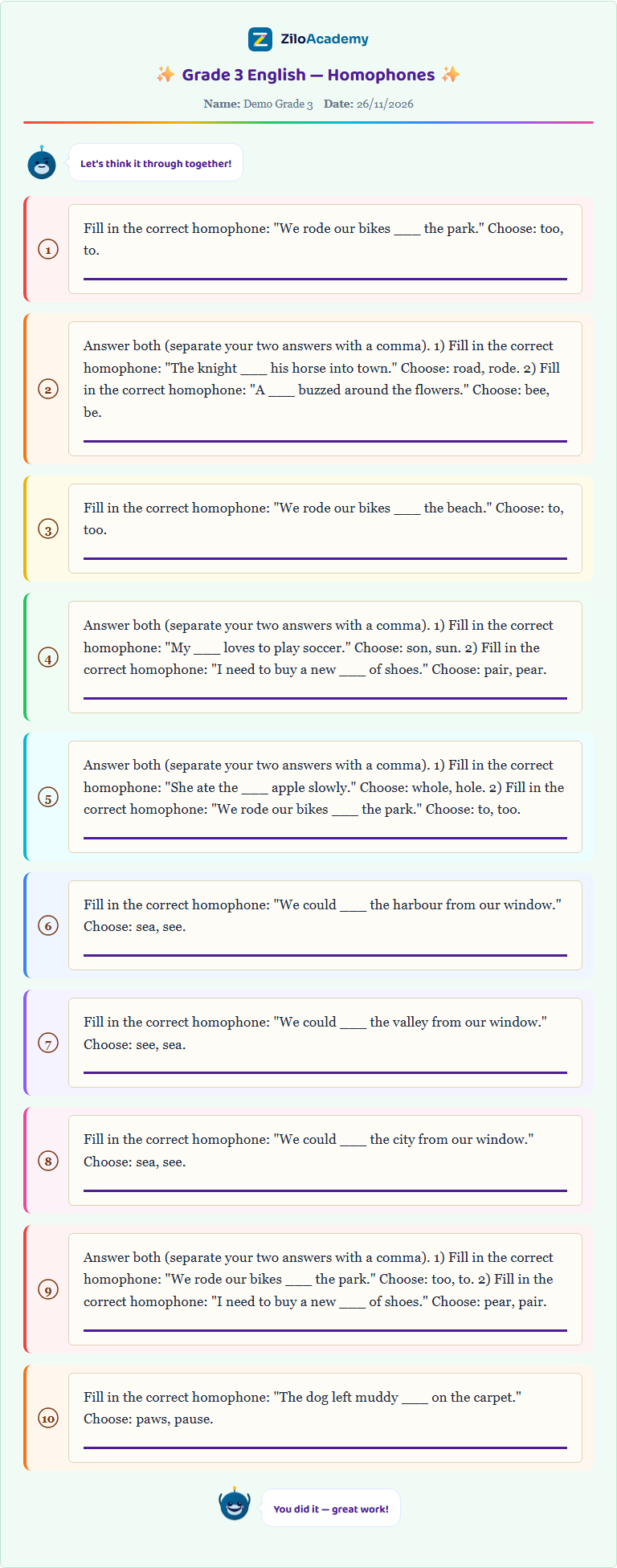
👆 This is what a real Year 3 Homophones Worksheets worksheet looks like
A real sample page — click the image to open the full worksheet and print it, with a fresh set of questions and an instant answer key.
👁️ View & Print This Worksheet →What Will Your Child Learn?
Year 3 homophones worksheets build recognising and correctly using common homophone pairs — their/there, to/too/two, where/wear — that sound identical but have different spellings and meanings. Worksheets include fill-in-the-blank practice and spot-the-error editing tasks.
Why Homophones Matters
Homophone mistakes are genuinely a spelling and meaning issue, not a pronunciation one, since a child reads the words correctly aloud but needs to know which spelling matches which meaning when writing.
This is also one of the most common error types that persists well past Year 3, even into adult writing, making early, deliberate attention to the most common pairs a genuinely worthwhile long-term investment.
How to Print the Worksheets
- Select the worksheet you want and open its printable view.
- Press Ctrl+P (Windows) or Cmd+P (Mac), or use your browser's Print option.
- In the print preview, choose A4 paper size.
- Set the layout to Portrait (most worksheets) or Landscape if the sheet is wide.
- Check the print preview to make sure nothing is cut off — adjust "Scale" or "Fit to page" if it is.
- Turn on "Black and white" or "Grayscale" in printer settings to save colour ink.
- Click Print — or choose "Save as PDF" as the destination to keep a digital copy instead.
Works the same way whether you're printing from Chrome, Edge or Safari, on a desktop, laptop or tablet. Full details, including printing from a phone and fixing content that's cut off, are in our complete guide to printing worksheets at home.
Tips for Parents
- Practise the most common pairs specifically — their/there/they're, to/too/two, your/you're — since these appear constantly
- Discuss the distinct meaning of each spelling in a pair, not just which one "looks right"
- Check your child's own writing specifically for homophone errors, as its own dedicated editing pass
- Use a memory trick for tricky pairs — "there" has "here" inside it, both about place
Frequently Asked Questions
📚 Helpful Guides for Parents
Get more out of every worksheet with practical tips from the Zilo Academy blog — study routines, NAPLAN advice and ways to support your child’s learning at home.