Year 4 Grammar Worksheets (Printable PDFs)
Printable Year 4 grammar worksheets from ZiloAcademy, covering compound and complex sentences, prefixes and suffixes, and commonly confused homophones. Aligned with the Australian Curriculum (Version 9.0).
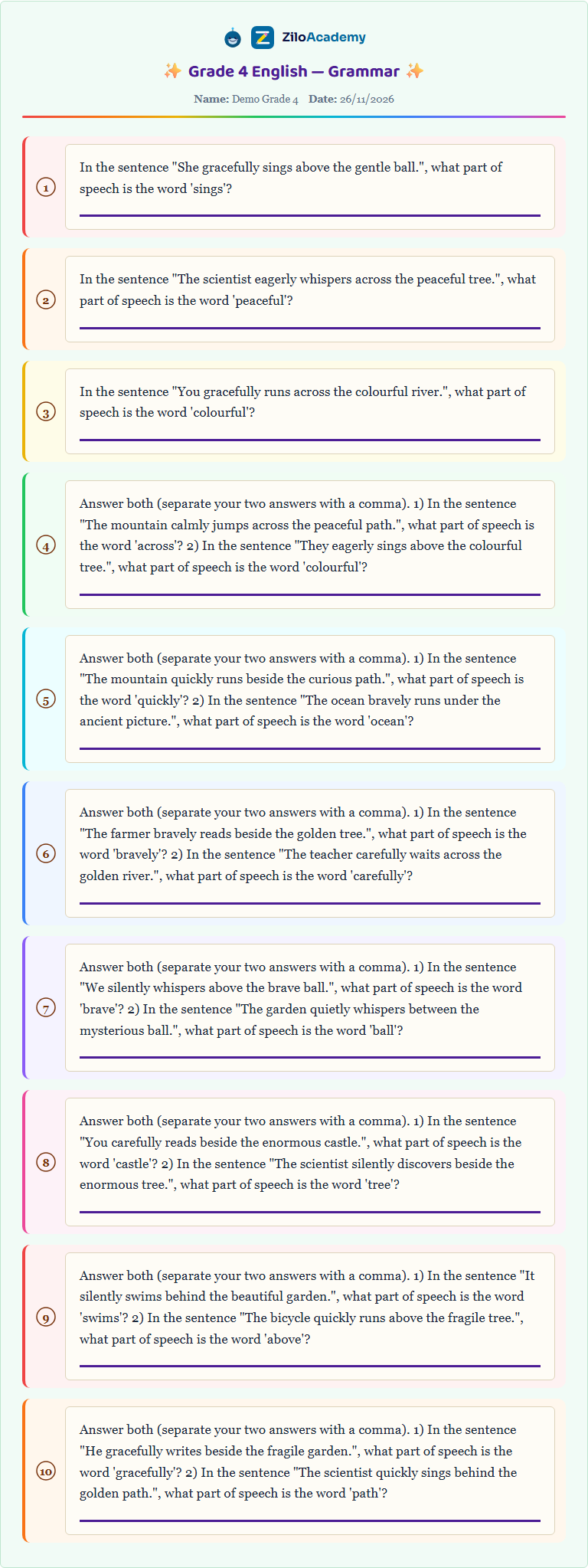
👆 This is what a real Year 4 Grammar Worksheets worksheet looks like
A real sample page — click the image to open the full worksheet and print it, with a fresh set of questions and an instant answer key.
👁️ View & Print This Worksheet →What Will Your Child Learn?
Year 4 grammar practice focuses on joining ideas into longer, more sophisticated sentences and building word meaning through prefixes and suffixes — key building blocks for the more structured writing Year 5 expects. Worksheets model a few combined-sentence examples before asking a child to combine their own, since seeing the pattern first makes independent practice far more successful.
Why Grammar Matters
Year 4 grammar is where writing starts moving from a series of short, simple sentences toward genuinely varied, connected prose — the difference between "The dog ran. It was fast. It chased the ball" and "The fast dog ran and chased the ball." That shift matters for every piece of writing from here on, including the persuasive and narrative structures Year 5 and Year 6 build on top of it.
Homophones deserve particular focus in Year 4 because they're exactly the kind of error that, left unaddressed, survives well into adult writing — "their/there/they're" mistakes are common far beyond primary school precisely because they're rarely given dedicated, deliberate practice. Catching and correcting the pattern now, rather than hoping it resolves through general reading and writing, saves a lot of quiet frustration later.
How to Print the Worksheets
- Select the worksheet you want and open its printable view.
- Press Ctrl+P (Windows) or Cmd+P (Mac), or use your browser's Print option.
- In the print preview, choose A4 paper size.
- Set the layout to Portrait (most worksheets) or Landscape if the sheet is wide.
- Check the print preview to make sure nothing is cut off — adjust "Scale" or "Fit to page" if it is.
- Turn on "Black and white" or "Grayscale" in printer settings to save colour ink.
- Click Print — or choose "Save as PDF" as the destination to keep a digital copy instead.
Works the same way whether you're printing from Chrome, Edge or Safari, on a desktop, laptop or tablet. Full details, including printing from a phone and fixing content that's cut off, are in our complete guide to printing worksheets at home.
Tips for Parents
- Model combining two short sentences into one before asking your child to try it independently
- Keep a running, visible list of homophones your child mixes up and revisit it in short, regular bursts
- Discuss what a new prefix or suffix does to a word's meaning whenever it comes up in reading
- Read your child's writing back to them aloud — this often reveals an awkward sentence join faster than reading silently
Frequently Asked Questions
📚 Helpful Guides for Parents
Get more out of every worksheet with practical tips from the Zilo Academy blog — study routines, NAPLAN advice and ways to support your child’s learning at home.