Year 7 Algebra Worksheets (Printable PDFs)
Printable Year 7 algebra worksheets from ZiloAcademy, covering writing and simplifying algebraic expressions and solving simple linear equations. Aligned with the Australian Curriculum (Version 9.0).
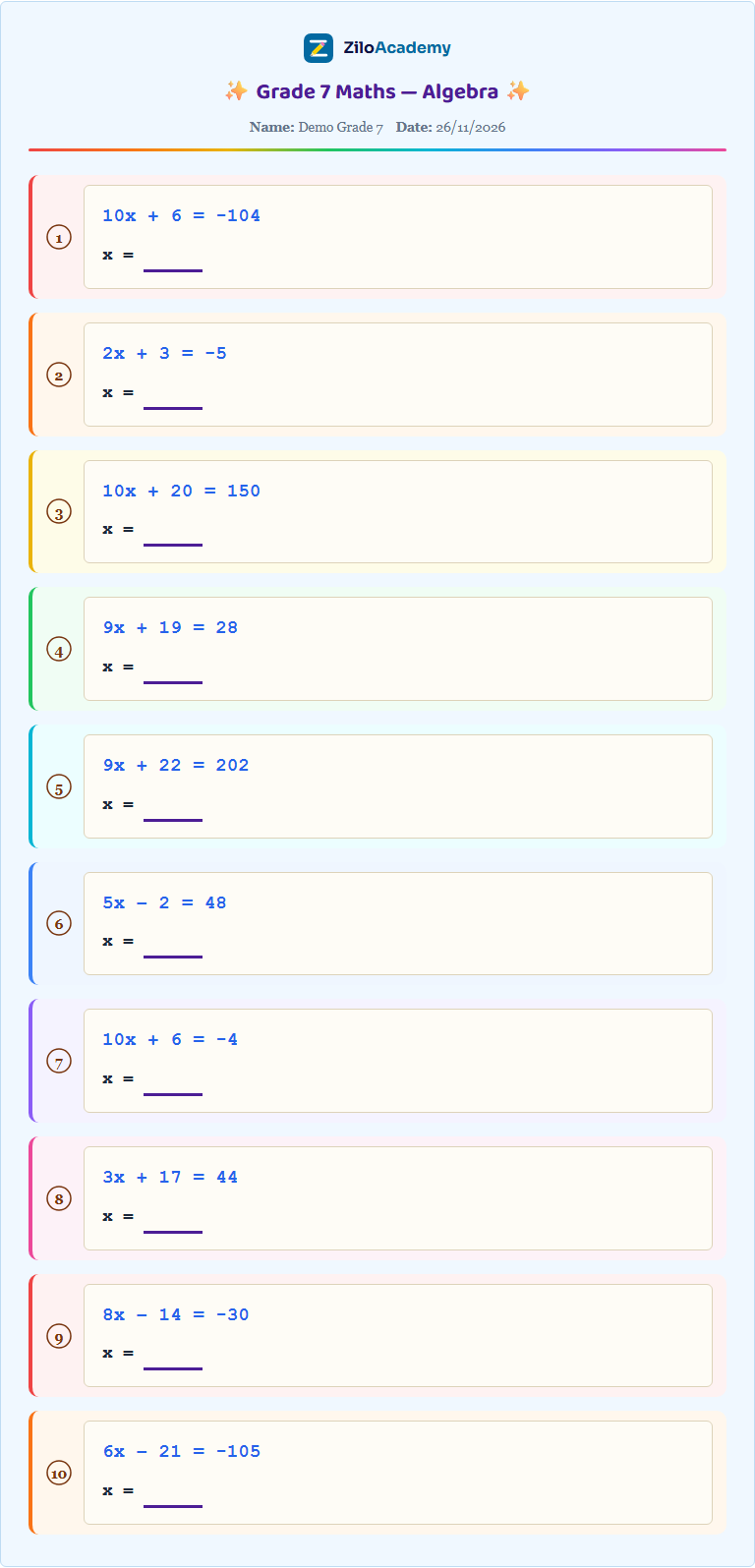
👆 This is what a real Year 7 Algebra Worksheets worksheet looks like
A real sample page — click the image to open the full worksheet and print it, with a fresh set of questions and an instant answer key.
👁️ View & Print This Worksheet →What Will Your Child Learn?
Year 7 algebra introduces genuinely new mathematical thinking — using letters to represent unknown numbers, simplifying expressions, and solving for an unknown value in a one- or two-step equation. Worksheets consistently start from a concrete pattern or real scenario before introducing letter notation, since algebra tends to click faster when it's framed as "a rule for a pattern" a child can picture, rather than an abstract symbol system presented cold.
Why Algebra Matters
Algebra is the first genuinely new kind of mathematical thinking most students meet — everything before it, no matter how advanced, has still involved working with specific, known numbers. Algebra asks a child to reason about a number without knowing its value yet, which is a real conceptual leap, not simply a harder version of arithmetic. Students (and sometimes parents helping them) often underestimate how different this is, expecting it to click as quickly as a familiar topic.
Because algebra underpins so much of secondary Maths from this point forward, genuine early understanding — not just memorised steps for solving a specific equation type — pays off for years. A student who understands why a step in solving an equation works, not just that it works, adapts far more easily when equations get more complex in later years, rather than needing to relearn the reasoning each time the format changes slightly.
How to Print the Worksheets
- Select the worksheet you want and open its printable view.
- Press Ctrl+P (Windows) or Cmd+P (Mac), or use your browser's Print option.
- In the print preview, choose A4 paper size.
- Set the layout to Portrait (most worksheets) or Landscape if the sheet is wide.
- Check the print preview to make sure nothing is cut off — adjust "Scale" or "Fit to page" if it is.
- Turn on "Black and white" or "Grayscale" in printer settings to save colour ink.
- Click Print — or choose "Save as PDF" as the destination to keep a digital copy instead.
Works the same way whether you're printing from Chrome, Edge or Safari, on a desktop, laptop or tablet. Full details, including printing from a phone and fixing content that's cut off, are in our complete guide to printing worksheets at home.
Tips for Parents
- Translate real situations into equations together before jumping to abstract practice — "I have some lollies, eat 3, and have 5 left" becomes x − 3 = 5
- Build the habit of checking a solved equation by substituting the answer back in — this catches errors and builds real confidence
- Expect algebra to take longer to click than a typically "harder version" of a familiar topic — it's a different kind of thinking, not simply more difficult arithmetic
- Celebrate understanding *why* a step works, not just getting to the right answer, since that's what transfers to new problem types later
Frequently Asked Questions
📚 Helpful Guides for Parents
Get more out of every worksheet with practical tips from the Zilo Academy blog — study routines, NAPLAN advice and ways to support your child’s learning at home.