Year 7 Quadrilaterals Worksheets (Printable PDFs)
Printable Year 7 quadrilaterals worksheets from ZiloAcademy, covering identifying and classifying quadrilaterals by their properties. Aligned with the Australian Curriculum (Version 9.0).
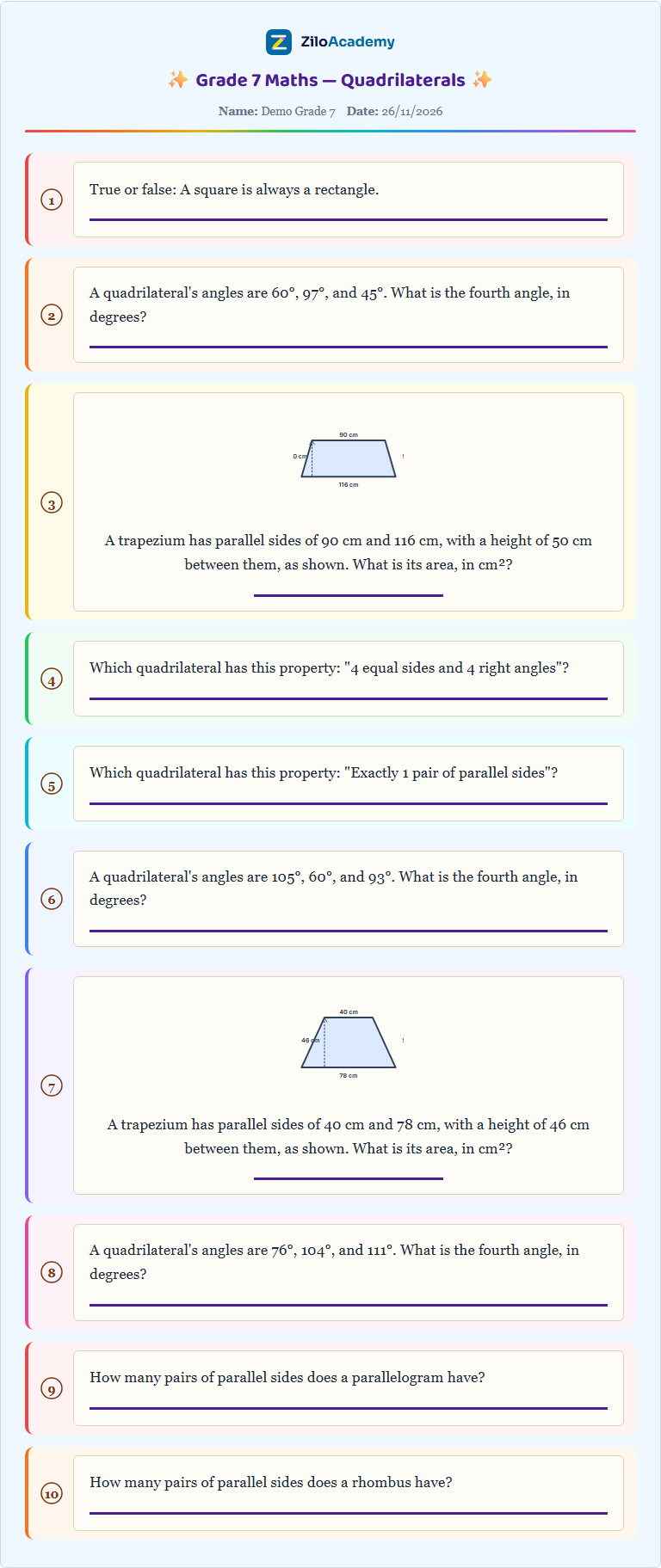
👆 This is what a real Year 7 Quadrilaterals Worksheets worksheet looks like
A real sample page — click the image to open the full worksheet and print it, with a fresh set of questions and an instant answer key.
👁️ View & Print This Worksheet →What Will Your Child Learn?
Year 7 quadrilaterals worksheets build identifying and classifying four-sided shapes — squares, rectangles, parallelograms, rhombuses, trapeziums and kites — by their specific side, angle and diagonal properties, plus using the fact that a quadrilateral's interior angles always sum to 360°. Worksheets emphasise the relationships between quadrilateral types, not just memorising each one separately.
Why Quadrilaterals Matters
Quadrilaterals genuinely relate to each other in a nested hierarchy — every square is a rectangle, every rectangle is a parallelogram — and understanding that structure, rather than treating each shape as an isolated fact, builds real geometric reasoning that serves a student well beyond this one topic.
Being able to classify a shape from its stated properties alone, without seeing a labelled diagram, is specifically what distinguishes genuine understanding from shape recognition by sight — and it's exactly the kind of question that appears in NAPLAN-style testing.
How to Print the Worksheets
- Select the worksheet you want and open its printable view.
- Press Ctrl+P (Windows) or Cmd+P (Mac), or use your browser's Print option.
- In the print preview, choose A4 paper size.
- Set the layout to Portrait (most worksheets) or Landscape if the sheet is wide.
- Check the print preview to make sure nothing is cut off — adjust "Scale" or "Fit to page" if it is.
- Turn on "Black and white" or "Grayscale" in printer settings to save colour ink.
- Click Print — or choose "Save as PDF" as the destination to keep a digital copy instead.
Works the same way whether you're printing from Chrome, Edge or Safari, on a desktop, laptop or tablet. Full details, including printing from a phone and fixing content that's cut off, are in our complete guide to printing worksheets at home.
Tips for Parents
- Build the hierarchy explicitly — a square is a special rectangle, which is a special parallelogram — rather than treating each as separate
- Practise classifying a shape from a list of properties alone, without a picture, to build real understanding
- Memorise that quadrilateral interior angles always sum to 360°
- Look for quadrilaterals in everyday objects and identify their specific type and properties
Frequently Asked Questions
📚 Helpful Guides for Parents
Get more out of every worksheet with practical tips from the Zilo Academy blog — study routines, NAPLAN advice and ways to support your child’s learning at home.