Year 8 Irony Worksheets (Printable PDFs)
Printable Year 8 irony worksheets from ZiloAcademy, covering verbal, situational and dramatic irony in texts. Aligned with the Australian Curriculum (Version 9.0).
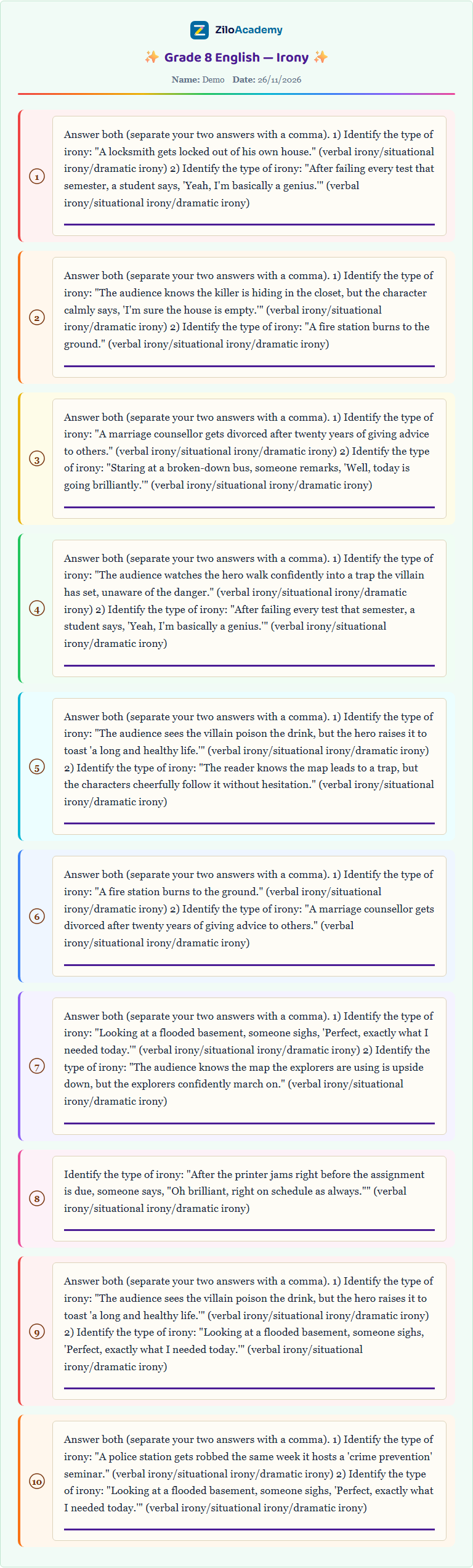
👆 This is what a real Year 8 Irony Worksheets worksheet looks like
A real sample page — click the image to open the full worksheet and print it, with a fresh set of questions and an instant answer key.
👁️ View & Print This Worksheet →What Will Your Child Learn?
Year 8 irony worksheets build identifying and naming the three main types of irony — verbal (saying the opposite of what's meant), situational (an outcome that contradicts expectation), and dramatic (the audience knows something a character doesn't). Worksheets include explaining exactly why a given example fits its specific irony type.
Why Irony Matters
Irony is a genuinely common but easily-missed literary device, and students who don't recognise it can take a sarcastic or ironic statement literally, missing the author's actual intended meaning entirely.
Naming the three distinct types precisely builds a more sophisticated analytical vocabulary, since dramatic, situational and verbal irony each create a genuinely different effect and work through a different mechanism.
How to Print the Worksheets
- Select the worksheet you want and open its printable view.
- Press Ctrl+P (Windows) or Cmd+P (Mac), or use your browser's Print option.
- In the print preview, choose A4 paper size.
- Set the layout to Portrait (most worksheets) or Landscape if the sheet is wide.
- Check the print preview to make sure nothing is cut off — adjust "Scale" or "Fit to page" if it is.
- Turn on "Black and white" or "Grayscale" in printer settings to save colour ink.
- Click Print — or choose "Save as PDF" as the destination to keep a digital copy instead.
Works the same way whether you're printing from Chrome, Edge or Safari, on a desktop, laptop or tablet. Full details, including printing from a phone and fixing content that's cut off, are in our complete guide to printing worksheets at home.
Tips for Parents
- Discuss real examples of verbal irony (sarcasm) in everyday conversation, since it's the most familiar type
- Spot situational irony in stories — an outcome that contradicts what was expected
- Discuss dramatic irony specifically, where the audience or reader knows something a character doesn't
- Ask "why is this ironic?" and require naming the specific type, not just recognising irony generally
Frequently Asked Questions
📚 Helpful Guides for Parents
Get more out of every worksheet with practical tips from the Zilo Academy blog — study routines, NAPLAN advice and ways to support your child’s learning at home.