Year 9 Scientific Notation Worksheets (Printable PDFs)
Printable Year 9 scientific notation worksheets from ZiloAcademy, covering converting to and from scientific notation, and multiplying and dividing numbers written this way. Aligned with the Australian Curriculum (Version 9.0).
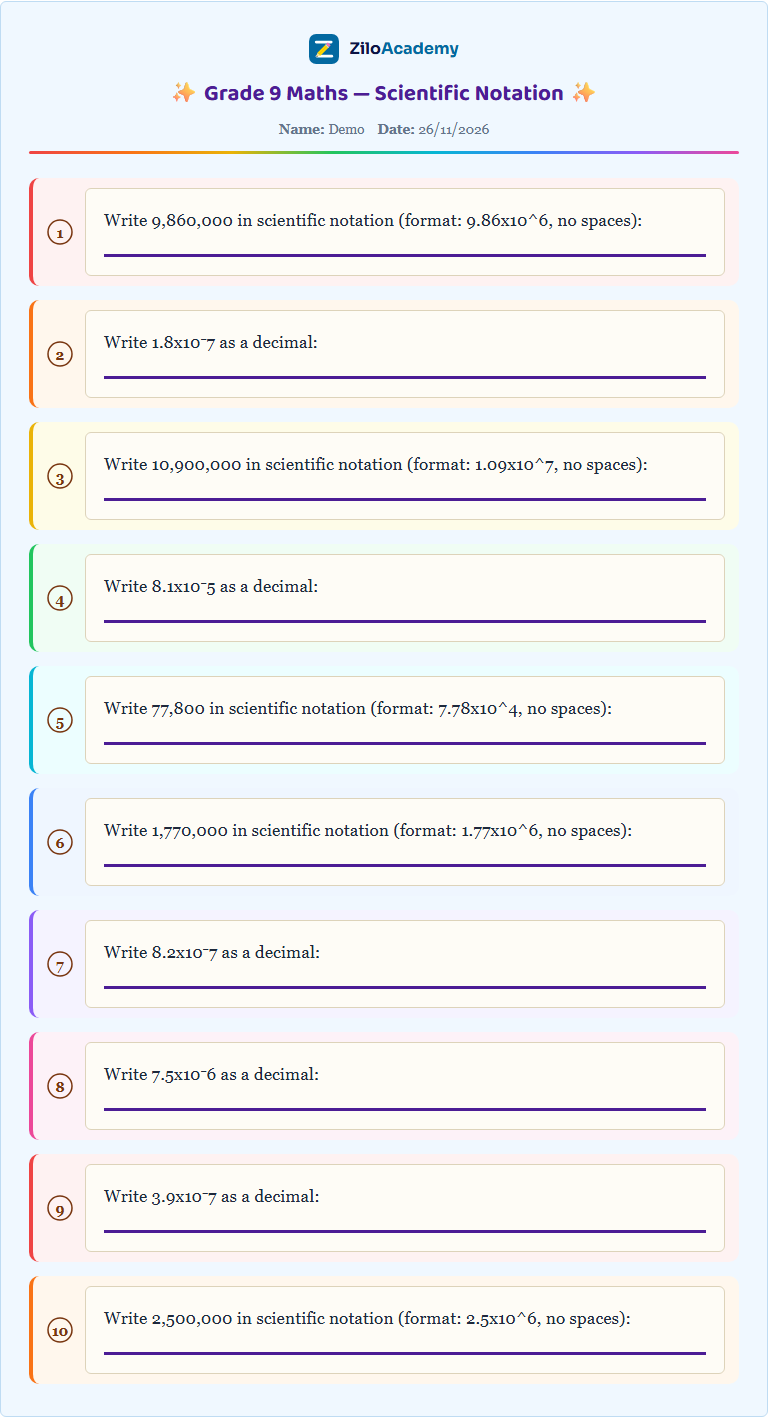
👆 This is what a real Year 9 Scientific Notation Worksheets worksheet looks like
A real sample page — click the image to open the full worksheet and print it, with a fresh set of questions and an instant answer key.
👁️ View & Print This Worksheet →What Will Your Child Learn?
Year 9 scientific notation worksheets build fluent conversion between standard and scientific notation in both directions, for both very large and very small numbers, then apply index laws to multiply and divide numbers already written in scientific notation. Worksheets use genuinely large and small real-world figures — distances in space, measurements in microns — so the practical reason for using scientific notation at all stays visible throughout.
Why Scientific Notation Matters
Scientific notation isn't just a Maths convention — it's the standard way very large and very small numbers are actually written in science, engineering and any field dealing with real-world measurement, so fluency here has genuine use well beyond the Maths classroom. Year 9 is where this needs to move from "a format I can decode with effort" to something read and written as naturally as an ordinary number.
Multiplying and dividing numbers in scientific notation directly tests whether index law fluency (built alongside this topic) actually transfers to a new, practical context — a genuinely useful check on whether the underlying skill is solid, not just the specific rule as originally taught.
How to Print the Worksheets
- Select the worksheet you want and open its printable view.
- Press Ctrl+P (Windows) or Cmd+P (Mac), or use your browser's Print option.
- In the print preview, choose A4 paper size.
- Set the layout to Portrait (most worksheets) or Landscape if the sheet is wide.
- Check the print preview to make sure nothing is cut off — adjust "Scale" or "Fit to page" if it is.
- Turn on "Black and white" or "Grayscale" in printer settings to save colour ink.
- Click Print — or choose "Save as PDF" as the destination to keep a digital copy instead.
Works the same way whether you're printing from Chrome, Edge or Safari, on a desktop, laptop or tablet. Full details, including printing from a phone and fixing content that's cut off, are in our complete guide to printing worksheets at home.
Tips for Parents
- Look up a few genuinely huge or tiny real numbers together (distance to the sun, size of a virus) and practise converting them to scientific notation
- Practise converting in both directions equally — many students get comfortable with one direction and avoid the other
- Connect scientific notation multiplication directly back to the index laws already learned, rather than treating it as a brand new rule
- Watch for the common error of not re-adjusting the decimal point correctly after multiplying or dividing the number parts
Frequently Asked Questions
📚 Helpful Guides for Parents
Get more out of every worksheet with practical tips from the Zilo Academy blog — study routines, NAPLAN advice and ways to support your child’s learning at home.